

Many proteins stick to the air-water interface of the thin sample film, drawn by hydrophobic patches on their surface, and they frequently do so in only a small number of orientations. The particles then present the same few views, collecting more of them does not fill the missing angles, and the reconstruction becomes direction-dependent, poorly resolved, or impossible.
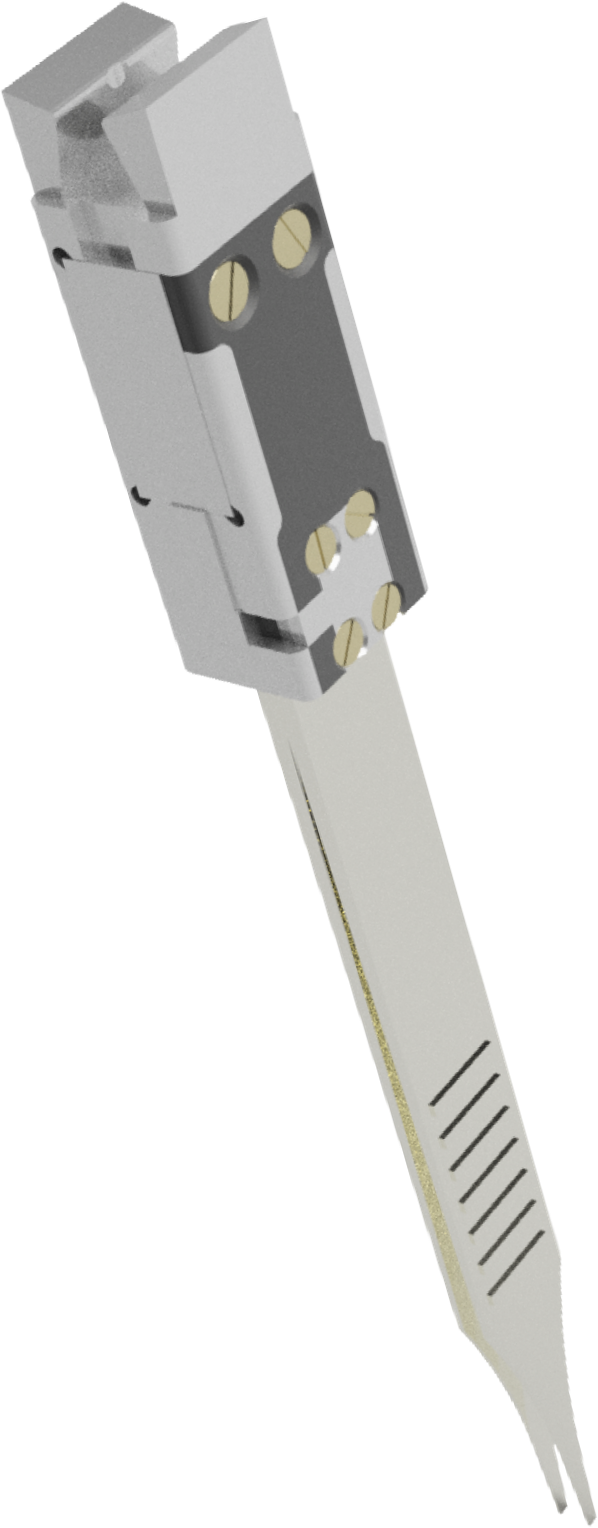
CryoShuffle targets the problem at its source. The tweezers deliver precisely timed ultrasonic excitation into the sample at the moment of plunging, sustained until the film vitrifies, so particles keep tumbling instead of settling into the same narrow set of orientations. In the hemagglutinin example, the reconstruction uses the sonicated dataset alone. Rapid vitrification preserves the redistributed orientations, improving angular sampling.
Scientific evidence
- Preprint. Williams et al., "Overcoming preferred orientation in cryo‑EM with ultrasonic excitation during vitrification," bioRxiv (2025). doi.org/10.1101/2025.09.14.676144
Related research: a different route
Straub et al., "Laser flash melting cryo-EM samples to overcome preferred orientation," Nature Methods (2025), demonstrates orientation redistribution by flash melting, not ultrasonic excitation.
The approach is covered by a patent application filed in 2025. It is one of five pending applications behind our products.